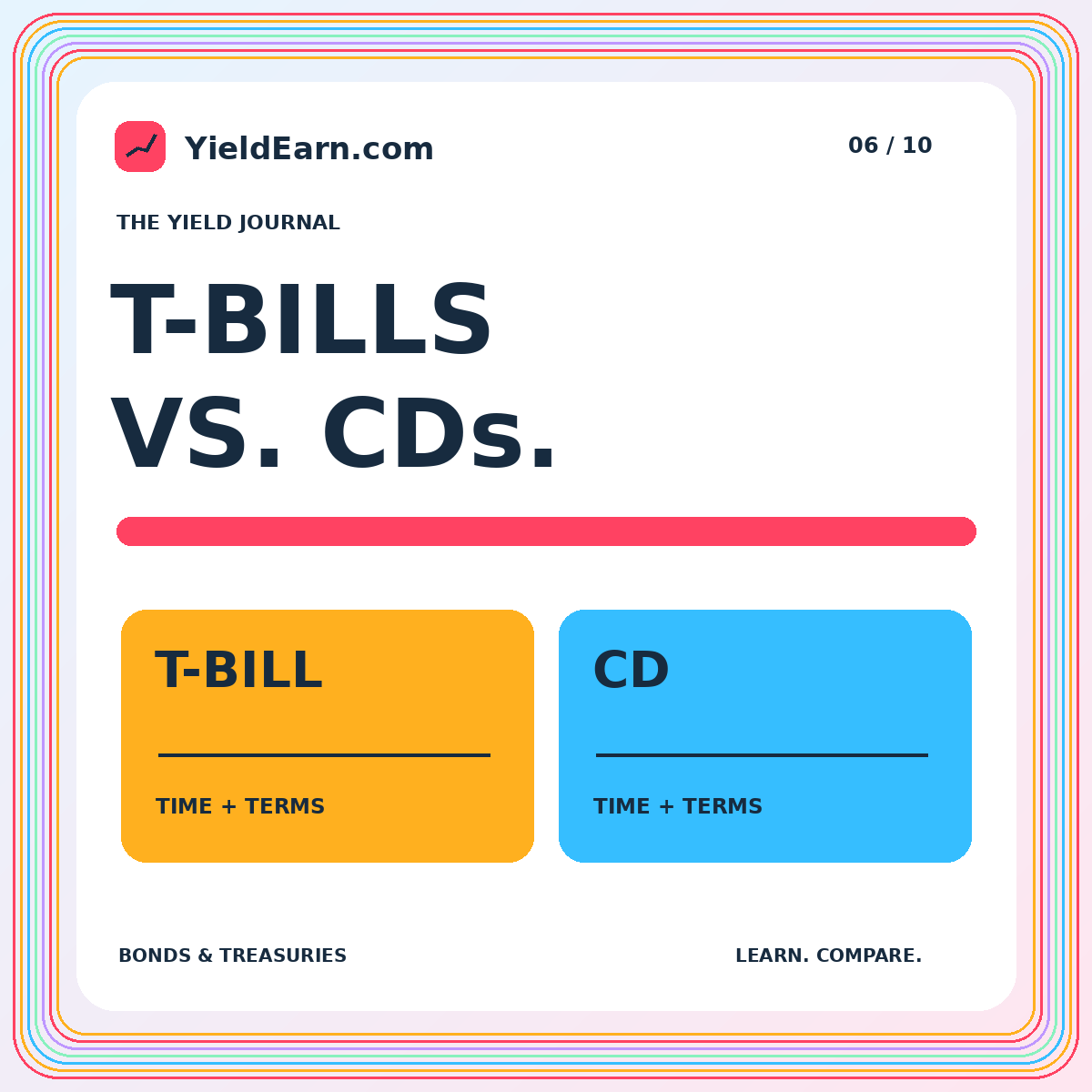
Treasury bills and CDs can both appear in a conversation about money needed on a future date. The similarity is useful, but limited. One is a U.S. government security; the other is a deposit product when issued as a bank or credit-union account. Their purchase process, yield quotations, protection framework, and early-exit mechanics are not the same.
This guide compares those structures without using live rates or recommending a security. Every numerical example is hypothetical. The Treasury learning page and CD rates guide provide the supporting questions. Begin with the amount and spending date, then examine whether either product's actual terms fit them. A familiar name does not remove the need to read the details.
Understand how a bill produces interest
A Treasury bill is a short-term marketable Treasury security. The TreasuryDirect explanation of Treasury bills describes how bills are sold at a discount or at face value and paid at face value at maturity. Unlike a conventional coupon-paying note or bond, a bill does not make periodic coupon payments during its term.
Imagine paying $9,900 for a bill that returns $10,000 at maturity. The $100 difference is the gross earnings in this simplified example. The actual term matters: receiving that difference after several weeks is not the same annualized outcome as receiving it after nearly a year. Keep purchase price, face value, and remaining days together whenever you examine a bill quotation.
A CD starts from a deposit agreement
For a conventional fixed-rate CD, you place money under an agreement specifying the term, rate, interest treatment, and redemption conditions. The displayed APY describes an annualized yield under the account's assumptions. The maturity proceeds may include interest retained in the account, or some interest may have been paid out earlier depending on the arrangement.
To compare the structures fairly, build a cash-flow line for each. Record money leaving your account, any payments during the term, and the final amount arriving at maturity. Avoid comparing a CD's full ending balance with only a bill's interest, or comparing bill proceeds that include principal with CD interest alone. Consistent accounting is essential before the percentages become useful.
Start with the actual date you need cash
A bill or CD should be examined against the spending calendar, not just the number of months in its name. The purchase or settlement date affects when the commitment begins, and the maturity date determines when the principal is due back. Confirm those dates for the actual instrument rather than assuming a label describes the exact holding period from today.
Leave room for the route from maturity proceeds to the final payment. The place where a security is held and the instructions on a deposit can affect the practical workflow. A planned expense is easier to support when the proceeds arrive before, rather than exactly at, the last possible moment. This is an operational planning principle, not a claim that a particular institution will delay your money.
Do not compare differently quoted yields blindly
Bills may be described using different annualized yield conventions. A CD typically advertises APY. Those numbers should not be assumed equivalent without checking the definition. Even when two quotations are mathematically comparable, unequal maturities can leave a gap that requires reinvestment at a rate not yet known. A larger displayed annual rate does not automatically settle the whole-horizon outcome.
A simple way to start is with dollar proceeds for the actual holding period. For the hypothetical $9,900 bill, the term return is $100 divided by $9,900, approximately 1.01%, before costs and taxes. Annualizing requires the day count and chosen convention. Keep that final step explicit rather than inventing a universal conversion or applying a deposit formula to a different quote without checking.
Use equal budgets, not mismatched face values
If the available budget is $10,000, a bill with $10,000 face value purchased below par may leave some uncommitted cash. A $10,000 CD uses the whole deposit amount in the comparison. That difference is small in some examples, but it should still be acknowledged. Otherwise the two alternatives are being measured on different amounts actually invested.
You can compare equal outlays, or compare practical purchase amounts while separately tracking leftover cash. Either approach is clearer than ignoring the mismatch. For a precise calculation, include available purchase increments, transaction costs, and settlement details. The purpose is not to make the arithmetic elaborate; it is to ensure that the alternatives are answering the same budget question.
Holding to maturity differs from leaving early
A maturity-based illustration assumes the instrument remains in place until its scheduled end and the issuer pays as promised. An early exit requires another analysis. A conventional bank CD may impose a contractual withdrawal penalty. An early sale of a marketable Treasury security occurs at a market price that may be above or below the purchase price, with applicable costs and holding-platform rules.
Do not describe a market sale as “withdrawing the deposit.” There is no deposit to withdraw from the bill itself. Conversely, do not assume a bank CD can be sold in the same way as a security. Brokered CDs add another structural distinction. Ask exactly how the particular product can be exited, what restrictions apply, and how the amount received would be determined.
Keep government backing and deposit insurance distinct
Treasury securities and insured deposits involve different protection frameworks. Treasury obligations are not insured bank accounts. A bank CD's coverage depends on the issuing institution, owner, and applicable insurance rules. Neither framework makes an early-sale price predictable or guarantees that purchasing power will be preserved after inflation and taxes.
For a deposit, identify the legal issuer and ownership arrangement using the official references in the source library. For a Treasury, understand the security and the platform through which it is held. Keep those checks apart from the yield calculation. Two products can both be discussed as conservative options while still presenting different practical risks and administrative obligations.
Reinvestment changes a longer comparison
Suppose a goal is one year away but the bill under consideration matures sooner. Buying that bill does not lock in the entire year's result. You must decide what happens to the proceeds for the remaining time. Using today's short-term yield for every later reinvestment creates an unsupported forecast, even when the first purchase's maturity proceeds are well defined.
Compare labeled scenarios for the remaining period instead. Ask whether the plan remains adequate if later reinvestment terms are less favorable. A CD ladder uses a similar scheduling idea, but it also leaves future rates uncertain. Multiple maturity dates can organize decisions; they do not reveal what those future decisions will pay.
Taxes and costs require your own applicable inputs
Tax treatment can differ by instrument, account type, and jurisdiction. This guide does not assign a tax rate or assume a particular exemption applies to a reader. Obtain the applicable treatment from current official guidance or a qualified professional, then compare after-tax dollar outcomes using consistent assumptions. A pre-tax yield gap is not automatically an after-tax advantage.
Also include costs that the actual holding arrangement introduces. A zero advertised trading commission does not necessarily answer every pricing or transaction-cost question. Ask for the relevant disclosures and verify whether a displayed return already includes a cost before subtracting it again. Our fees and inflation article shows a framework for separating gross income, net outcomes, and purchasing power.
The practical takeaway
Treasury bills and CDs can be compared thoughtfully, but not by treating every displayed percentage as the same measure. Align the budget, actual dates, cash-flow assumptions, exit method, costs, and applicable tax treatment. Then make clear which part of the result is fixed by the instrument and which depends on a future decision.
A useful comparison ends with an explanation rather than a universal winner. You should be able to say what you are buying, when money is due back, what happens if you need it earlier, and which assumptions drive the projected earnings. That clarity is what makes the comparison reusable after market quotations change.