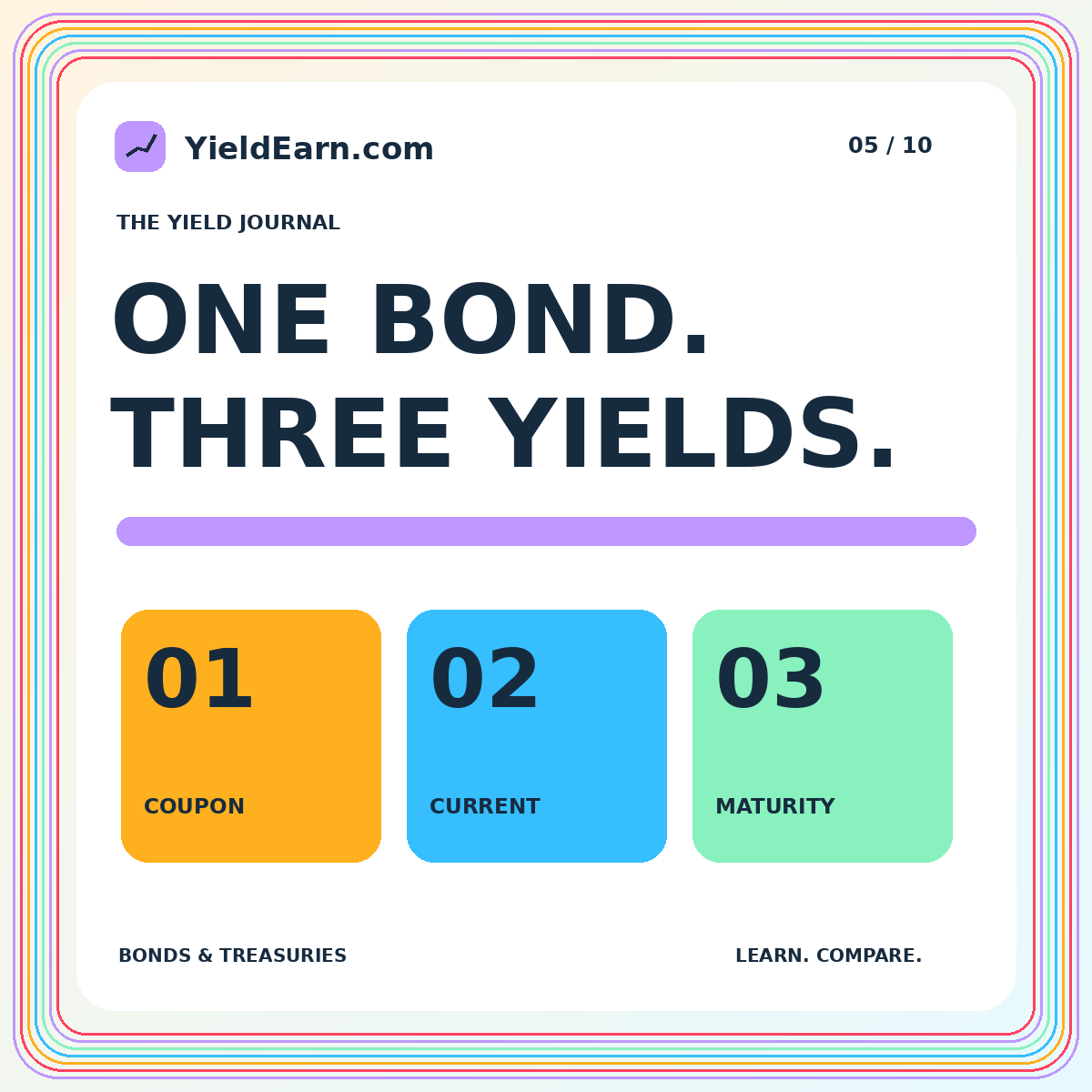
Two bonds can display the same percentage and still offer very different cash flows. Even one bond can have several yield figures at the same time. The confusion usually begins when a coupon rate, current yield, and yield to maturity are treated as alternative labels for the same thing. They are not. Each answers a different question.
This guide works through a simple fictional fixed-rate bond. It is not a quote or a recommendation to buy a security. For a broader view of credit, interest-rate, and liquidity risks, begin with the bond investing guide. Here the goal is narrower: understand exactly what a displayed yield measures and which important parts of the investment it leaves out.
Begin with the cash flows, not the percentage
Imagine a bond with $1,000 face value and a fixed $50 annual coupon, paid once a year for this illustration. Assume it has three years remaining and promises to repay $1,000 at maturity. The scheduled cash flows are $50 after year one, $50 after year two, and $1,050 after year three. Whether those payments actually arrive depends on the issuer meeting its obligations.
That schedule is the foundation. The price you pay may be above or below $1,000, but changing your purchase price does not itself change the fixed $50 coupon. Keep the contractual payments separate from the market transaction. This distinction makes the different yield measures much easier to understand and prevents a common mistake: assuming a discounted purchase increases the coupon dollars.
Coupon rate measures interest against face value
In the example, the coupon rate is $50 divided by $1,000, or 5.00%. It describes the fixed annual coupon relative to face value. It does not tell you the return from buying the bond at any particular market price. Paying $950 or $1,050 leaves the coupon rate at 5.00% under these assumptions.
FINRA's explanation of bond yield and return distinguishes coupon, current yield, and the forward-looking measures used for maturity or call scenarios. The practical reading habit is to look for the label immediately beside the number. A screen showing “5%” without saying what kind of yield it means is missing information you need for a fair comparison.
Current yield changes with purchase price
Current yield divides the annual coupon dollars by the bond's current price. At a hypothetical price of $950, the $50 coupon represents approximately 5.26%. At $1,050, it represents approximately 4.76%. These calculations use the same bond and the same scheduled coupon. Only the price denominator changes.
This explains the direction of the relationship without forecasting markets: when a fixed payment is divided by a lower price, the resulting percentage is higher. But current yield does not include the difference between the price paid and the principal repaid at maturity. It also does not describe a sale at some other future price. It is an income-to-price snapshot, not a complete holding-period return.
A premium or discount matters at maturity
Consider paying $1,050 for the example bond and receiving $1,000 at maturity. The $50 difference reduces the overall outcome relative to a calculation that looks only at coupon payments. Paying $950 and receiving $1,000 has the opposite effect. Both examples assume full and timely payment and ignore fees, taxes, and accrued-interest details to isolate the mechanism.
It would be incorrect to add the entire $50 price difference to the annual coupon and call the result a yearly yield. That gain or loss unfolds over the remaining term, and the timing of the cash flows matters. A more complete measure needs to incorporate each scheduled payment and the final principal amount. This is the question yield to maturity is designed to address.
Yield to maturity connects price and scheduled payments
Yield to maturity, or YTM, is the discount rate that makes the present value of the scheduled coupons and principal equal the purchase price. In the simplified annual-payment example, you would solve an equation with three discounted cash flows. It is not found by simply dividing the total dollars received by the price and then ignoring when those dollars arrive.
At a $1,000 purchase price, the example's 5.00% coupon and annual-payment assumptions produce a 5.00% YTM. A $950 price produces a YTM above 5.00%; a $1,050 price produces one below 5.00%. The exact numbers depend on the full payment schedule and market conventions. The directional comparison is useful, but it is not a substitute for checking the security's actual terms.
A quoted YTM is not a guaranteed realized return
YTM uses promised cash flows and holding-to-maturity assumptions. An issuer may fail to pay, a bond may be sold early, or a callable security may be redeemed under its terms. Taxes and transaction costs can also change the investor's outcome. Reading YTM as an unconditional promise discards precisely the risks that make bonds require analysis.
There is also a distinction between the internal rate of return on the scheduled payments and a terminal wealth projection that assumes coupons are reinvested at the same rate. Reinvesting coupons at a different rate changes that accumulated wealth. State your purpose: are you measuring the yield implied by a price, or forecasting what reinvested cash might become? They are related calculations, but not identical questions.
Calls introduce another possible ending
A callable bond gives the issuer specified redemption rights. If the issuer exercises them, the bond's cash-flow timeline can end before the stated maturity. A yield-to-call calculation uses the relevant call date and call price instead of the final maturity schedule. Investors therefore need to examine more than the most attractive maturity-based number on the screen.
Yield to worst considers the relevant contractual redemption scenarios under the measure's assumptions. Despite the name, it is not a floor on all possible losses. Default or an unfavorable market sale can produce a worse result. Treat the word “worst” as part of a technical yield definition, not as a universal guarantee. Ask which scenarios the provider actually included in its calculation.
Selling early creates a different question
Suppose you buy the fictional bond at $950, receive one $50 coupon, and sell it a year later for $920. Ignoring taxes, fees, and accrued interest, the holding-period gain is $20: the coupon less the $30 price decline. Dividing $20 by $950 gives approximately 2.11%. The initial current yield of 5.26% did not describe that realized outcome.
A sale at $980 would instead produce an $80 gain, or approximately 8.42% on the same simplified basis. Neither sale price is a forecast. Together they illustrate why a yield quote cannot settle the return from a future early sale. A plan that depends on selling before maturity should explicitly consider market-price uncertainty, not just the bond's payment schedule.
Make comparisons on a consistent basis
Before comparing two bond yields, align the metric, remaining term, credit exposure, currency, payment schedule, and call features. Then identify whether quoted yields include relevant transaction costs. A longer, riskier, or callable security can display a larger number without being a like-for-like alternative. A percentage difference is only meaningful after the surrounding conditions are understood.
Do not compare a bond's current yield directly with a deposit APY as though both incorporate the same assumptions. Our yield comparison page puts the measures side by side, while the Treasury bills versus CDs guide shows another case where annualization and timing require care. The goal is not to avoid comparison, but to compare the actual structures rather than just their labels.
The practical takeaway
Coupon rate describes the scheduled interest relative to face value. Current yield relates that interest to market price. Yield to maturity connects the price with all scheduled payments under stated assumptions. None replaces an assessment of issuer risk, early-sale risk, costs, or the timeline of your goal.
When reading a bond quote, write down the metric's name and the cash-flow scenario it assumes. Then ask what would change if the bond were sold, called, or not paid as scheduled. Understanding those conditions is more useful than selecting the largest number from a screen of yields that were never directly comparable.