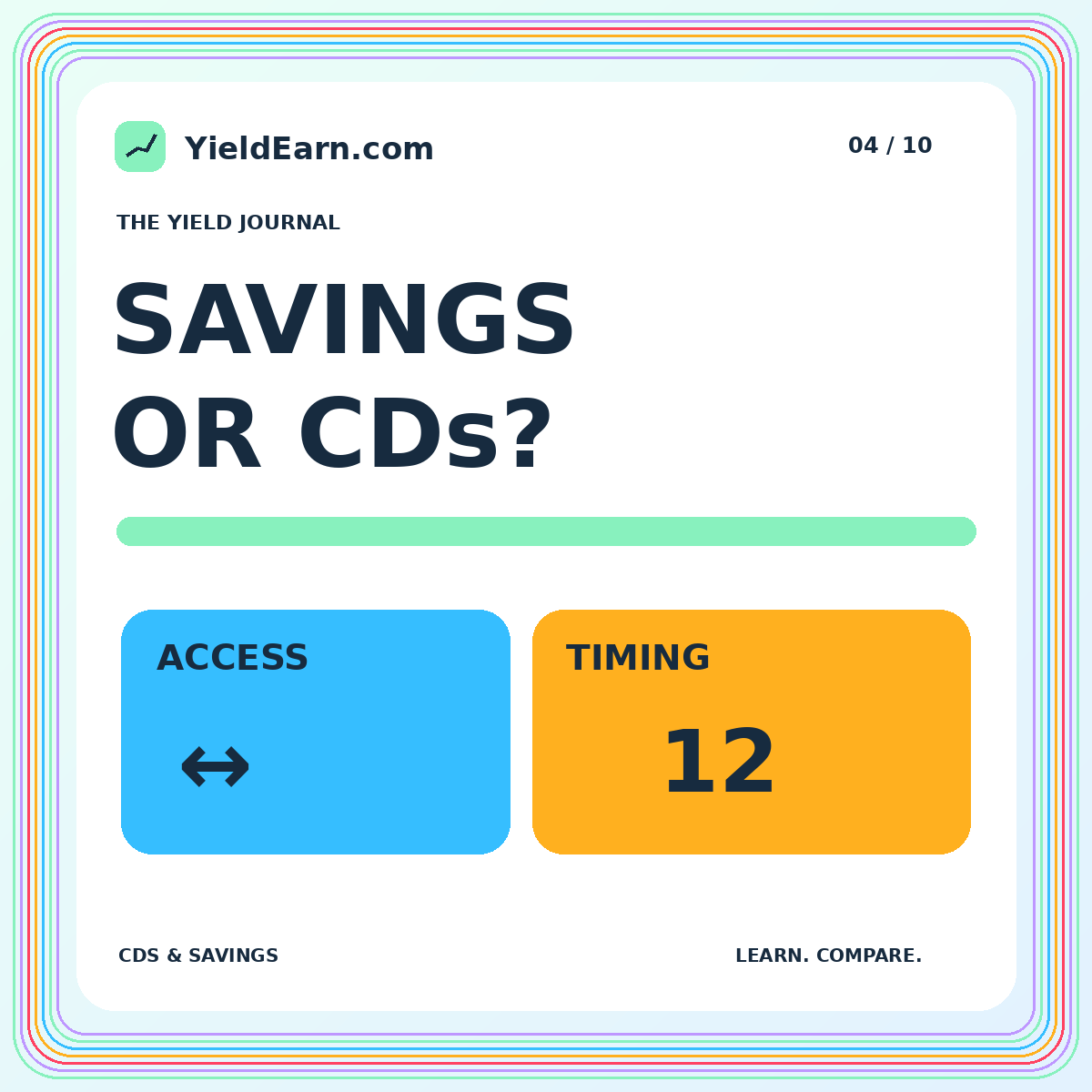
A CD ladder is a schedule before it is an investment strategy. Instead of putting an entire deposit into one maturity, you divide it among CDs ending at different times. That can give you several opportunities to use or reinvest money. The appeal is not that the arrangement knows where rates are going; it is that the decision points are visible.
This guide describes an illustrative planning method, not a recommended allocation. Your emergency needs, deposit terms, and account coverage come first. The CFPB's CD overview explains the basic time commitment and the usual consequence of withdrawing early. Staggering maturities does not remove the terms attached to each individual account.
Start with a list of possible spending dates
Before drawing evenly spaced rungs, list the expenses the money might serve. Separate a known payment next summer from an uncertain emergency and a longer-term goal. They are different demands on cash. A ladder designed only to look tidy can still be a poor fit when a large expense falls between maturity dates.
Imagine someone has $20,000 they are considering for this exercise. That is not automatically the amount to ladder. Some of it may need to remain accessible outside CDs. After identifying money that can genuinely be committed, map the potential maturity schedule against the dates on the spending list. Work from access needs toward products, rather than selecting attractive terms and hoping the calendar cooperates.
Understand a simple three-rung example
Suppose an educational example divides $15,000 into three $5,000 deposits maturing after four, eight, and twelve months. At month four, the first rung becomes a decision point. It can be used for a goal, held in accessible savings, or reinvested if the person's circumstances and the available terms justify doing so. The other two rungs remain subject to their agreements.
This example deliberately avoids projecting rates. The maturity dates are the organizing feature. The ladder initially contains different terms, so each rung may have a different APY and dollar interest amount. Equal starting deposits do not necessarily produce equal proceeds. Keep a separate line for principal and interest rather than labeling every maturity as exactly $5,000 of available cash.
A ladder is not the same as monthly income
Maturity proceeds include the return of your own principal. If a $5,000 CD matures and pays $5,080 in total, only $80 is interest in this hypothetical example. Calling the full $5,080 income would confuse recycled savings with earnings. That distinction matters when comparing a ladder with a strategy intended to support recurring spending.
Interest payout frequency is another separate feature. A CD may credit or pay interest on a schedule that does not match its maturity. Ask whether interest stays in the account or transfers elsewhere. Your cash-flow plan should distinguish periodic interest payments from the larger principal amount arriving at maturity. Otherwise the same dollars can accidentally appear twice in an income forecast.
Build a useful maturity record
For each rung, write the issuing institution, ownership registration, amount, opening date, maturity date, APY, payout arrangement, withdrawal policy, and renewal instructions. Save the product disclosure alongside that record. A short note describing the purpose of the money is also useful: tuition, a possible move, or a reserve for a later purchase.
Add two operational dates: when you intend to review the rung and when instructions must reach the provider. Check the contract rather than assuming a standard grace period. The review date should give you time to reconsider the goal and learn the new options. A ladder is easier to manage when it includes decisions and deadlines, not just a row of account balances.
Reinvestment is a choice, not a rule
Many descriptions of ladders suggest automatically rolling every maturing rung into the longest term. That is one possible approach, but it can quietly extend the plan beyond the original goal. A person saving for a purchase in eighteen months should reconsider whether a new multi-year commitment still serves that purchase when an early rung matures.
Write a simple decision question for every renewal: “When could this particular money be needed now?” If the answer has moved closer, keeping the proceeds accessible may fit the plan better than preserving a visually symmetrical ladder. If the goal has moved farther away, a new term might be considered. Maintaining the diagram should never become more important than meeting the expense it was designed to support.
Test falling and rising rate scenarios
A ladder creates multiple reinvestment dates, which means later rates will matter. If future offers are lower, a maturing rung may earn less when renewed. If they are higher, money already committed elsewhere does not automatically receive the new rate. Staggering can spread exposure to these decisions, but it cannot guarantee the most favorable result in either direction.
Use scenarios without attaching invented probabilities. Ask what the plan looks like if the next rung renews at a lower rate, the same rate, or a higher rate. Then ask a more important question: does the goal still work in the lower-income case? The exercise is about the plan's resilience, not predicting policy changes or deciding that one maturity is destined to outperform another.
Look at liquidity between the rungs
A maturity every four months is not the same as access every day. If an expense occurs shortly after a rung renews, the ladder might leave little immediately available without an early exit. Draw the full timeline and mark the longest gap between accessible amounts. This is often more revealing than counting the number of CDs.
Consider whether the amount arriving at each date is enough for the possible spending need. A small rung maturing soon does not solve a much larger immediate bill. The savings-versus-CD comparison explains why accessible savings and term deposits can have different jobs. This is not a requirement to use both; it is a reminder that the access question deserves its own answer.
Complexity has a cost even without an account fee
Five institutions and twelve small rungs may create more reminders, statements, transfers, and renewal decisions than a person wants to manage. A small increase in expected interest can come with substantial administrative effort. Convert any rate advantage into dollars before deciding that additional accounts are worthwhile. A simpler schedule can be easier to maintain accurately.
Also review the underlying institution and ownership details across the arrangement. Multiple account numbers do not necessarily create independent coverage. The source library points to official deposit-insurance information. Keep those checks separate from the ladder arithmetic; the diagram itself says nothing about whether a particular collection of deposits is within applicable coverage limits.
Avoid the three common modeling mistakes
First, do not use the highest rung's APY for the entire ladder. Each deposit has its own term and return assumptions. Second, do not treat a maturity as profit when most of it is principal. Third, do not assume a future renewal rate is already locked. These errors can make a modest scheduling tool look like a far more powerful earnings strategy than it is.
For a transparent estimate, calculate each rung independently and add cash flows on their actual dates. Keep the reinvestment assumptions in a separate section. The APY explainer shows how to translate annualized yield into a term-specific estimate. When your assumptions become complicated, simplify the illustration rather than hiding the uncertainty behind a precise-looking total.
The practical takeaway
A useful CD ladder connects available money with possible spending dates and makes the next decision easy to find. It can provide structure without requiring a view about future rates. It does not eliminate withdrawal restrictions, reinvestment uncertainty, inflation, or the need to confirm deposit coverage.
Start with the calendar, keep accessible needs outside commitments that cannot meet them, and reconsider each rung as it matures. The strongest sign that the ladder fits is not that every rung rolls forward indefinitely. It is that you can explain when the money becomes available, what it is for, and what you will review before committing it again.